Why Businesses Need Specialized Commercial Movers
Why Do Businesses Need Specialized Commercial Movers Instead of Standard Movers?
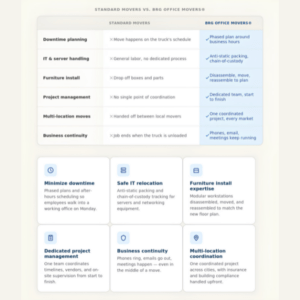
Relocating a business is nothing like moving a house. A residential move involves boxes, furniture, and a weekend of effort. A business relocation involves servers, workstations, confidential files, phone systems, and dozens (sometimes hundreds) of employees who need to be back at their desks and productive as soon as possible. That is exactly why commercial movers exist as a distinct category of moving company, built around a different set of priorities: speed, precision, data security, and business continuity.
If you are a business owner, office manager, or facility manager planning an upcoming move, understanding the difference between standard movers and specialized commercial movers can save your company time, money, and a significant amount of stress. This guide breaks down what sets commercial moving services apart, what to expect from a professional office movers team, and how to choose the right commercial relocation company for your organization.
The Real Benefits of Hiring Specialized Commercial Movers
- Minimizing Downtime and Protecting Revenue
Every hour a business is not operational is an hour of lost productivity, missed calls, delayed client work, and potential revenue loss. BRG Office Movers specializes in commercial relocation that protects business continuity. Their teams build move schedules around your operating hours, often working nights and weekends so employees walk into a fully functional workspace on Monday morning.
A commercial office relocation company like BRG Office Movers will typically:
- Create a phased moving plan so departments are relocated in a logical sequence
- Schedule the bulk of the physical move outside of core business hours
- Coordinate building access, freight elevators, and parking with property management in advance
- Have contingency plans ready in case of delays, weather, or building restrictions
- Safe, Strategic IT Equipment Relocation
Few things are more disruptive to a business than a damaged server, a lost hard drive, or a phone system that will not reconnect. BRG Office Movers treats IT relocation as a dedicated workstream, separate from general furniture moving, ensuring mission critical technology is protected from disconnect to reconnect.
This typically includes:
- Disconnecting, labeling, and packing servers, workstations, and networking equipment
- Using anti-static materials and specialized crating for sensitive electronics
- Coordinating with your internal IT team or vendor for reconnecting and testing
- Chain of custody tracking so nothing goes missing between locations
Standard movers are not trained or equipped for this level of care, which is why businesses with any meaningful technology footprint need a commercial relocation company that treats IT assets as mission critical.
- Office Furniture Moving and Installation Expertise
Modern offices are filled with modular furniture systems, workstations, cubicles, and ergonomic equipment that were never designed to be casually disassembled and reassembled. Professional office movers bring furniture specific expertise to the table, including:
- Proper disassembly and reassembly of modular workstations and cubicle systems
- Reconfiguration of furniture layouts to match a new floor plan
- Protection of finishes, glass, and upholstery during transit
- Installation services so employees arrive at a fully set up workspace, not a pile of parts
This is where the difference between commercial moving services and general moving labor becomes clear. BRG’s furniture installation capabilities eliminate downtime and prevent costly rework.
- Dedicated Project Management From Start to Finish
One of the most valuable advantages of hiring BRG Office Movers is the project management layer that oversees every detail of your relocation. BRG assigns a dedicated team to coordinate planning, communication, scheduling, and on site execution.
This structure is essential for large scale office moves involving multiple departments, floors, or locations.
Project management support typically includes:
- Space planning and pre move labeling systems
- Vendor and building management coordination
- Timeline development and milestone tracking
- On site supervision during the move itself
- Post move walkthroughs to confirm everything landed where it should
This structure is especially important for large scale office moves involving multiple departments, multiple floors, or multiple office locations, where a single missed detail can cascade into delays across the entire organization.
- Business Continuity as the Guiding Principle
Ultimately, every benefit above rolls up into one overarching goal: business continuity. Workplace relocation services are built around the idea that a move should be nearly invisible to your customers and clients. Phones should still ring. Emails should still go out. Meetings should still happen, even if they happen from a temporary space for a day or two.
Standard movers are not equipped to think this way because their job typically ends when the truck is unloaded. A specialized commercial relocation company plans around your operational needs first and treats the physical move as one part of a much bigger continuity strategy.
Why Business Relocation Requires More Than Manpower
It is easy to assume that a move is simply a matter of having enough people and enough trucks. In reality, a successful business relocation service depends on a combination of experience, planning tools, and industry specific know how that general labor cannot replicate.
Some of the additional considerations a commercial moving services provider manages include:
- Certificates of insurance and building compliance: Most commercial office buildings require movers to carry specific insurance coverage and submit documentation before they are allowed access.
- Asset management and inventory tracking: Larger relocations often require warehousing and asset management for furniture or equipment during a phased move or downsizing.
- Industry specific requirements: Healthcare facilities, laboratories, and hospitality environments have unique regulatory and handling requirements that go far beyond typical office relocation services.
- Multi location and national coordination: Businesses relocating across multiple cities need a partner with the scale and local expertise to execute simultaneously across locations in different markets.
This is where the depth of an established commercial relocation company becomes clear. It is not just about moving items from point A to point B. It is about protecting the business itself throughout the transition.
Protect your business during its next move. Connect with BRG Office Movers to plan a commercial relocation that keeps your operations running smoothly.
Frequently Asked Questions
Do commercial movers supply their own packing materials and labeling supplies?
Yes. Professional office movers typically bring crates, anti static wrap, furniture pads, and a color coded labeling and signage system as part of the service, so your team is not responsible for sourcing packing materials or figuring out how to organize boxes by department or destination.
What should employees do to prepare their own workstations before moving day?
Most commercial relocation companies run employee packing and labeling training sessions ahead of the move, asking staff to clear personal items, back up files stored locally rather than on a shared server, and pack small desk items into provided bins. The moving crew then handles the furniture, monitors, and larger equipment, so employees are not left dismantling their own desks.
How are confidential documents and sensitive files protected during a business relocation?
Reputable commercial movers use locked bins or sealed crates for files, track everything through an asset management and inventory system, and can coordinate directly with your compliance or legal team on handling requirements for regulated industries such as healthcare, finance, or law.
Can a commercial relocation company handle a move to a different city or state?
Yes. Larger commercial moving services providers operate hubs across multiple markets and can manage an interstate relocation as a single coordinated project, rather than handing the job off between unrelated local movers at each end of the move.
What happens to old office furniture or equipment we no longer need?
Many commercial movers offer decommissioning as part of their warehousing and asset management services, which can include donation coordination, recycling, or disposal of outdated furniture and electronics, so your business is not left storing or hauling away items that will not make the move to the new space.
Are commercial movers licensed and insured, and what does that cover if something is damaged?
Established commercial relocation companies carry general liability insurance and cargo coverage, and can provide certificates of insurance that meet the requirements of most commercial buildings. It is worth contacting the moving company directly to confirm coverage limits and ask how claims for damaged furniture or equipment are handled before the move begins.
 FIND OUR NEAREST OFFICE MOVING LOCATION